



Gilded bronze Empire style chandelier with angels, 20th century
Luxury antiques
SKU: ANT-A1136
See other products from category Vintage chandeliers or from manufacturer Antyki with shipping within 24 hours
Related products by category
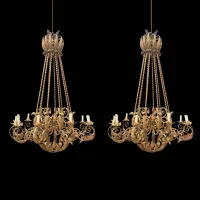
Handcrafted wrought iron chandelier pair, dating from around 1970. Monumental, twelve-arm Italian chandeliers from the winter garden of an old rural villa in Lombardy, in good condition. The masterful
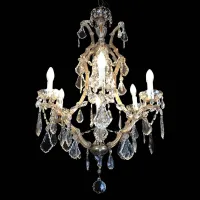
Crystal chandelier Maria Teresa with 7 lamps from 1950, functional, with 6 miniature external lamps and one large central one. All crystals are in good condition. The electrical installation works ev
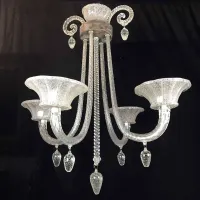
Blown glass chandelier from the 1940s with four E14 bulbs placed in four large glass bowls, with the crowns facing upwards. In the photos, we present this antique chandelier made in Murano, recently p
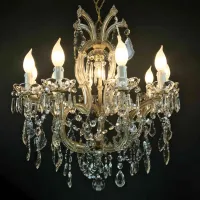
Restored crystal chandelier, dating from around 1950, completely renewed in every element. Thanks to its compact proportions, it features 10 external E14 lights mounted on a lacquered wooden candle ho
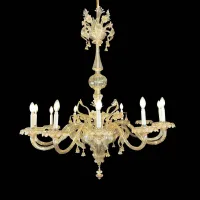
A large chandelier with 12 lights made of blown glass, early 20th century. This elegant Venetian-style chandelier with 12 blown glass lights, crafted by masters of Venetian glass art from the early 20
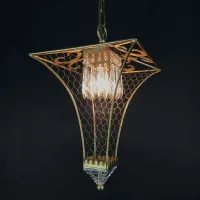
Golden iron and crystal lantern with 1 light. An entrance chandelier made of gilded iron with a pagoda structure, protected on both sides by a rhomboidal metal mesh, always gold-plated. The upper par
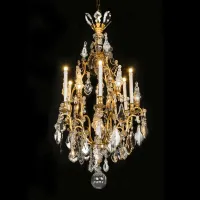
French chandelier from 1900, gilded bronze and crystal with thirteen light bulbs, in excellent condition. Made with six lights positioned on curved double spiral arms, finished with floral orm
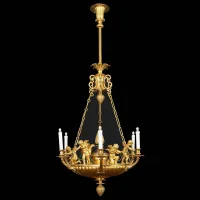
Empire-style chandelier made of gilded bronze with putti. An Italian chandelier featuring winged angels made of gilded bronze, with intricately carved castings and high-quality gilding, dating from ar
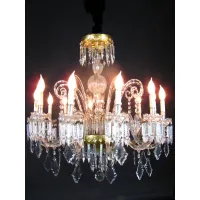
Antique Crystal Bohemia chandelier with 12 arms. An elegant hollowed-out chandelier made from Czech crystal with twelve flames from around 1950; it features a central stem in the shape of a baluster,
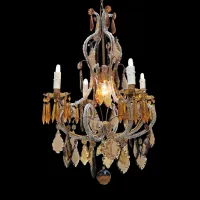
Chandelier made of transparent crystal and amber with five lamps, crafted from a round structure of gilded iron with a square cross-section, forming a cage with four curved pillars completely covered
Description
Empire-style chandelier made of gilded bronze with putti. An Italian chandelier featuring winged angels made of gilded bronze, with intricately carved castings and high-quality gilding, dating from around 1950. The chandelier is Italian and originates from the 1950s. The image is in good condition, ready to hang, with the gilding cleaned and the fixture rewired.
This elegant, six-arm, gilded chandelier is suspended by three chains attached to a gilded bronze casting, which surrounds a pinecone-shaped finial; the casting is connected to a ceiling rosette by a tall, fluted tubular element; the three chains support the lamp shade, a round shade decorated at the bottom with an elegant pattern resembling a seed pod, ending with a decorative pinecone motif. The same pinecone motif is located above the cup in the center of six winged cherub figures. Around the perimeter of the cup, near the edge, are six cupids. These are six angels, alternately standing and kneeling, holding a chain with both hands.
The cup has six curved arms ending in bobèches, each holding an electric candle compatible with E14 bulbs. The maximum power is 500 watts.
Exceptional antique furniture and accessories can be an excellent idea for decorating our interiors. Today, there is an increasing number of enthusiasts of high-quality vintage items that possess a distinct character and soul. This is a nod to history, craftsmanship, and the design of {traditional|classic} and timeless furniture. There are many different styles in antique furniture, each with its distinctive features.
Many styles characterize antique furniture, but a few are particularly notable. Eclectic furniture from the 19th century is associated with the prevailing Biedermeier style. Its early 20th-century variants include neo-Gothic, Gothic, Rococo, Louis Philippe style, and the English Victorian style. Toward the end of the century, these styles evolved into pseudo-classicism, Renaissance, and Baroque styles.
Beautiful Empire-style furniture dates from the late 18th to early 19th century. It originated during Napoleon’s reign, which imposed a significant resemblance to Roman and Greek decorative motifs.
Neoclassical furniture is associated with Louis XVI style, which also draws heavily from ancient architecture. Antique products in Rococo and Louis XV styles are also interesting and worth noting. Baroque, whose name derives from the Portuguese 'barocco'—meaning an irregularly developed pearl—was characterized by very ornate furniture designed to exude splendor and play a significant role in luxury. Unique, selectively used materials were employed to emphasize the grandeur of these pieces.
Today, we can observe how much influence the Baroque style has had on modern classic furniture, which is designed with a strong resemblance to the historical period. An important style is also Renaissance, which flourished in the 15th and 16th centuries and left a significant mark on furniture design. Renaissance furniture was quite heavy and massive, often using brown stains, with cornices, sturdy bases, and reliefs. These products were quite distinctive but also opened new possibilities, such as the construction of credenzas and broadly conceived chest furniture. During this period, mythology and ancient themes were also popular, with supports and legs taking animal forms.
Lion paws, eagle heads—these are common features in Renaissance style. Currently, many global brands reproduce such furniture, inspired by Italian and French artisans. This reflects admiration and respect for the history of the most beautiful Renaissance antiques. It’s important to remember that furniture production was perceived differently in each country, giving each style a unique character. This is especially important when searching for a luxurious antique piece that suits your interior.
Attributes / Details
| SKU | ANT-A1136 |
| Manufacturer | Antyki |
| Model | A1136 |
| Material | ormolu |
| Size | Height: 147 cm Diameter: 70 cm |
| Age | XX |
| Year | 1900 |
| Destiny | To living room |
See catalog
Reviews
No reviews for this product.