

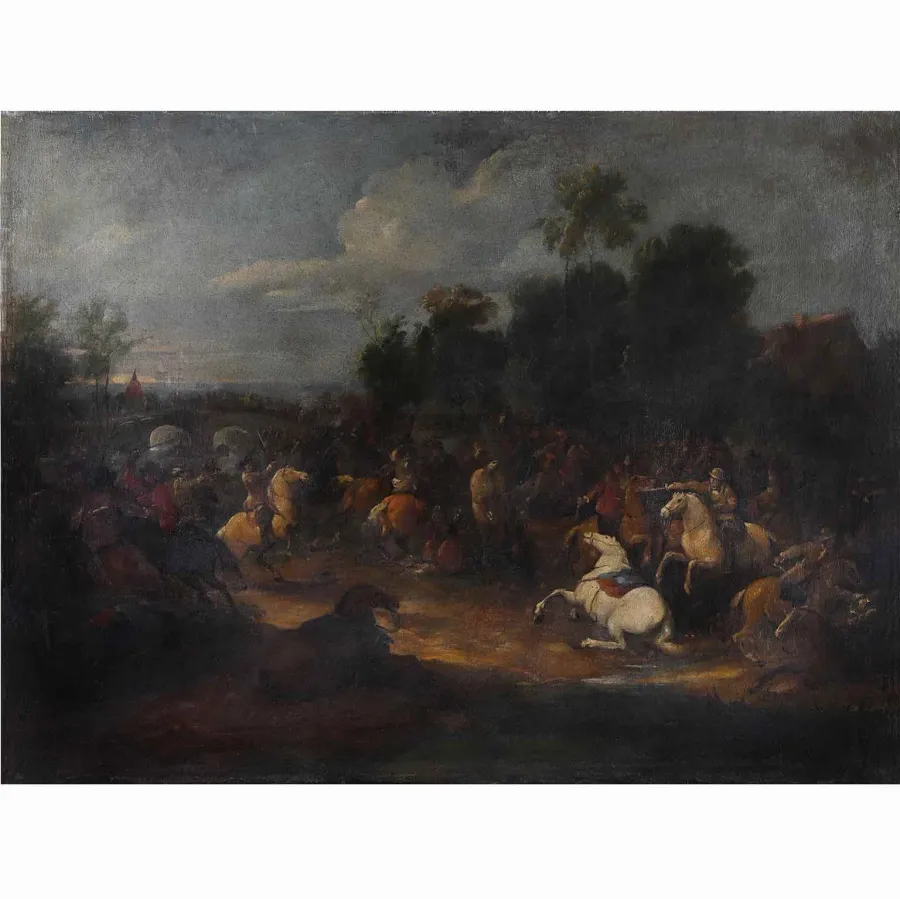
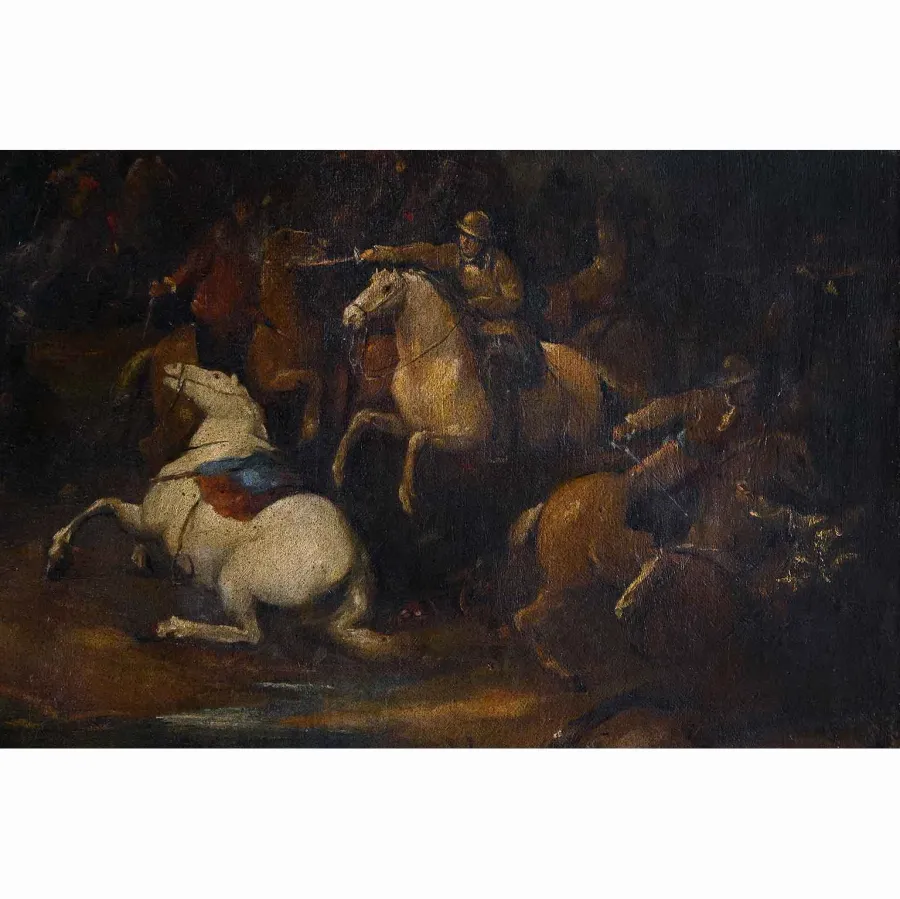
19th century battle scene in a Flemish school with bridge and river landscape
Stylish antique furniture and accessories
SKU: ANT-A841
See other products from category Antique paintings or from manufacturer Antyki
Related products by category
From Italy, an original colorful view of Milan depicting the Ticinese Darsena Navigli canal with boats and buildings, oil painting on canvas signed by C.Castelfranchi Milano by the Italian painter Cir
19th-century wax model from Northern Europe, polychromed wax composition depicting four figures in 17th-century costumes in a festive setting, dancing, with two of them playing wind instruments. In th

Portrait of a lady from the Flemish school painted with oil paints on a rectangular cardboard with an oval, gold-layered cardboard backing. It depicts a mature woman dressed in a black dress, a lace c
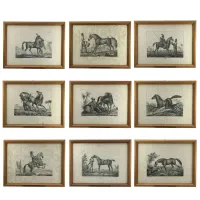
Horse Breeds Known in Europe, Firenze 1822 – a unique set of nine stone lithographs by Italian painter, engraver, and graphic artist Luigi Giarrè (c. 1772-1844). Italian publisher Litografia Ridolf
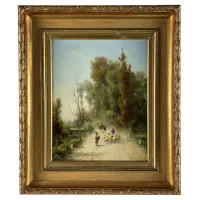
Oil painting on canvas by Silvio Poma, “Landscape with Shepherds,” depicts a dirt road amidst a wooded landscape, as well as farmers grazing a flock of sheep. On the left side of this rural Lombar
Beautiful antique furniture and accessories can be an excellent idea for decorating our interiors. Today, there is an increasing number of enthusiasts of high-quality vintage items that possess a dist
Beautiful antique furniture and accessories can be an excellent idea for decorating our interiors. Today, there is an increasing number of enthusiasts of high-quality vintage products that possess a d
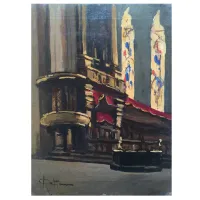
Achille Cattaneo Church Interior Oil Painting on Canvas from the early 20th century, signed at the bottom left, A. Cattaneo by Milanese artist Achille Cattaneo (Limbiate 1872 - Milan 1932), probably
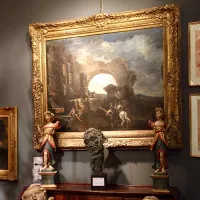
Grand landscape with ruins from 1700. Capriccio with ruins and figures, oil painting on canvas, early 18th century, good condition. Capriccio is a term coined at the end of the Renaissance and has se
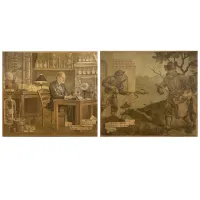
Borghetto JJ the Alchemist and the Snake Hunter 1945 A pair of large pendant paintings of French origin; the first depicts rather an alchemist than a pharmacist or chemist sitting in his laboratory wi
Description
The scene depicts a Flemish school battle scene from the late 19th century, featuring a cavalry clash over a bridge with a river landscape in the background. This antique oil painting of a battlefield was restored approximately thirty years ago. It is in good condition.
The canvas has recently been cleaned, and the frame has been repainted and gilded.
Exclusive antique furniture and accessories can be an excellent idea for decorating our interiors. Today, there is an increasing number of enthusiasts of high-quality vintage items that possess a distinct character and soul. This is a nod to history, craftsmanship, and the design of classic and timeless furniture. There are many different styles in antique furniture, each with its own characteristic features.
Many styles distinguish antique furniture, but a few are particularly notable. Eclectic furniture refers to the 19th century, especially the beloved Biedermeier style. Its early 20th-century variants include neo-Gothic, Gothic, Rococo, Louis-Philippe style, and finally the Victorian English style. By the end of the century, these styles evolved into pseudo-classicism, Renaissance, and Baroque styles.
Empire-style furniture dates from the period between the late 18th and early 19th centuries. It originated during Napoleon’s reign, characterized by strong similarities and references to Roman and Greek ornamentation.
Neoclassical furniture reflects the Louis XVI style, which also draws heavily from ancient architecture. Noteworthy are antique products in Rococo and Louis XV styles. Next is Baroque, a term derived from the Portuguese 'barocco'—meaning an irregularly developed pearl. These were highly ornate, luxurious pieces designed to radiate splendor and play a significant role in opulence. Materials were selectively chosen to emphasize the grandeur of these items.
Today, we can observe how much influence the Baroque style has had on modern classic furniture, which is often designed with a strong resemblance to the historical period. The Renaissance style is also significant. Flourishing in the 15th and 16th centuries, it left a substantial mark on furniture-making. Renaissance furniture was quite heavy and robust, often using brown stains, moldings, sturdy bases, and bas-reliefs. These products were quite distinctive but also introduced new possibilities, such as the construction of cabinets and broadly speaking, chest-type furniture. During this period, mythology and antiquity were also of interest, with supports and legs often taking animal forms.
Lion paws and eagle heads are common motifs in Renaissance-style furniture. Currently, many global brands reproduce such furniture, inspired by Italian and French artisans. This reflects admiration and respect for the history of the most beautiful Renaissance antiques. It’s important to remember that furniture production was perceived differently in each country, giving each style a unique character. This is especially important when searching for an exclusive antique that suits your interior.
The most important aspect of original antique furniture is authenticity. Ultimately, this is crucial for buyers, as many forgeries circulate on the market. Luxury Products provides documentation confirming the product’s authenticity and correspondence to its description and photos. We also have access to art appraisers, historians, and experts from around the world.
Attributes / Details
| SKU | ANT-A841 |
| Manufacturer | Antyki |
| Model | A841 |
| Size | height: 121 (100) cm, width: 151 (130) cm, depth: 7 cm |
| Age | 19th century |
See catalog
Reviews
No reviews for this product.