

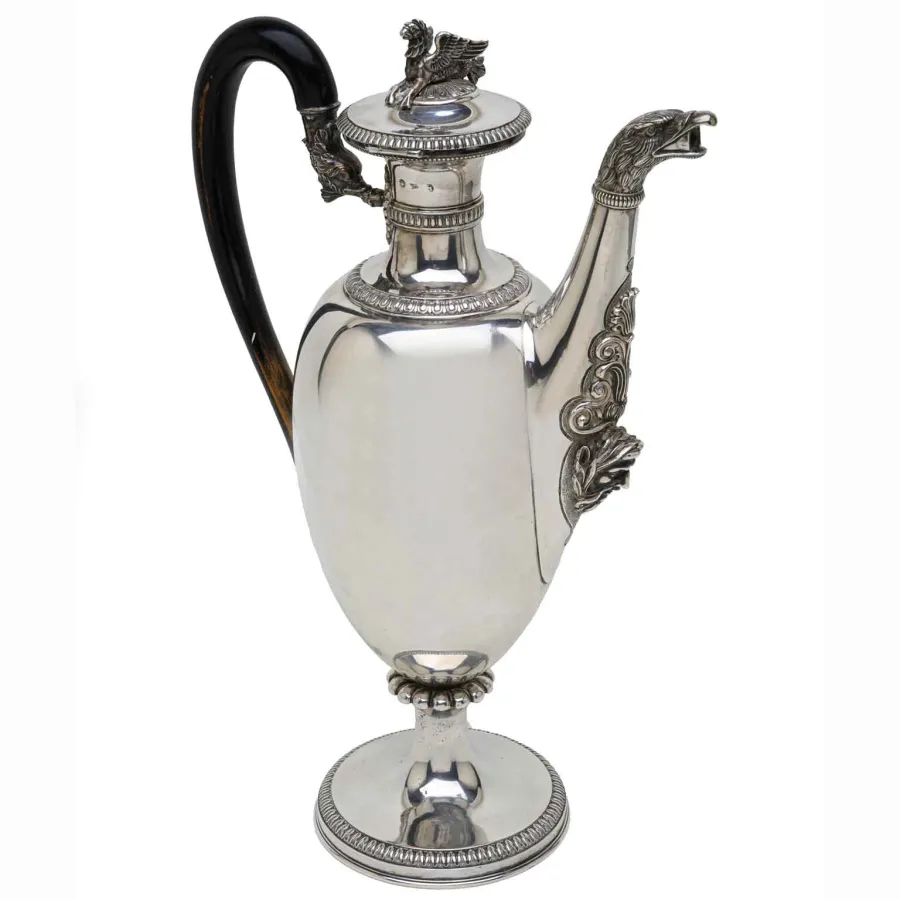
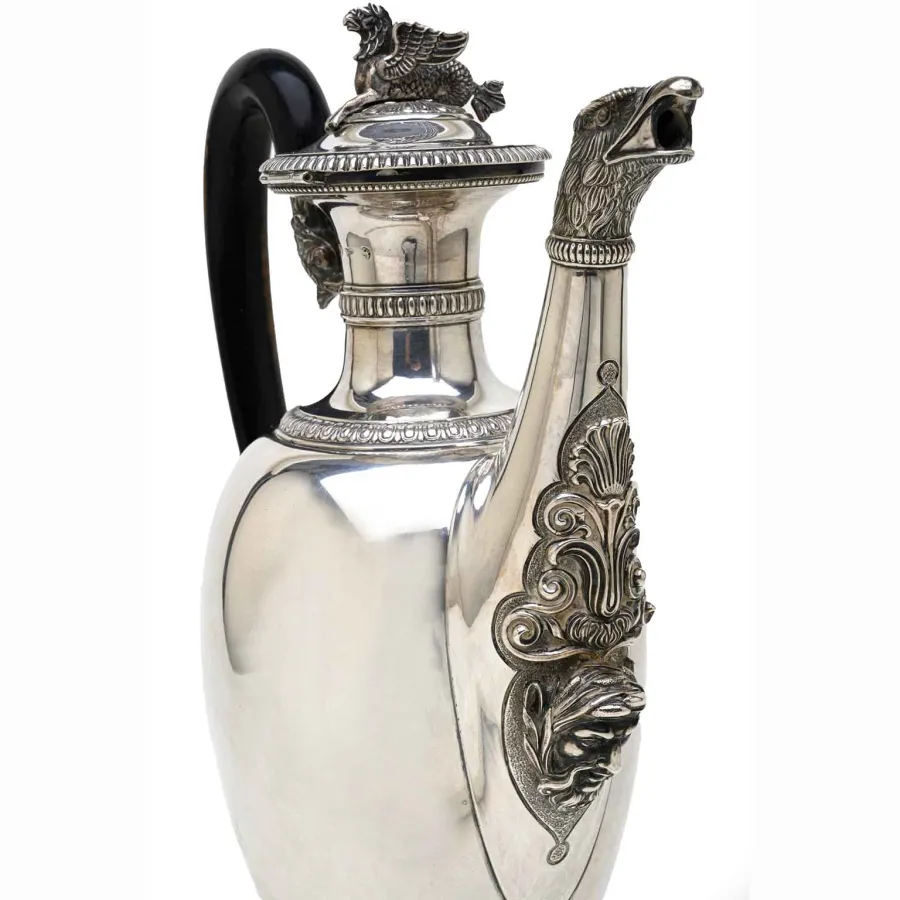
Large silver coffee pot, Empire, Milan, early 19th century
Luxury antique furniture and accessories
SKU: ANT-A648
See other products from category Coffee and tea services and sets or from manufacturer Antyki
Related products by category
Set includes:In the coffee set, you will find 6 coffee cups, 6 saucers, sugar bowl, coffee pot,milk jug.Porcel brand offers more than just an ordinary product, as it provides an exceptionally luxuriou
Tea set with tray consisting of a teapot, coffee pot, milk jug, sugar bowl with tongs, and a large rectangular tray. The service is in good condition, with no dents or visible marks, has handles made
Porcel brand offers more than just a product; it presents an exceptionally elegant concept of design, a lifestyle, and inspiration from the applied arts, with a capital S. Founded in 1987 in Portugal,
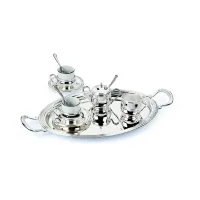
The presented set will be perfect for two people who start each day with a good espresso. Coffee cups Chinelli are an excellent choice – they are both timeless and very, very elegant.Coffee Service
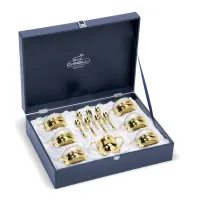
A beautiful set housed in a leather-lined box is the epitome of elegance, featuring a tea service. Chinelli coffee and tea services will impress your guests. The presented set is both elegant and time
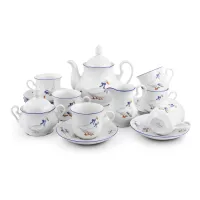
Exceptional design combined with the highest quality materials embodies the essence of Rudolf Kämpf manufactory. It is a tribute to genuine porcelain, which has fascinated and inspired a love for bea
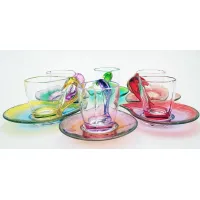
Italian company Perle d’Arte has been painting luxury glass and crystal items for over twenty years.Although the process is complex, artistic glassware like no other delights the eye, and every love
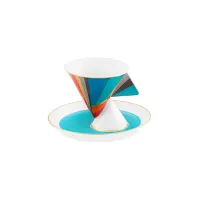
Vista Alegre was the first industrial unit dedicated to porcelain production in Portugal. The determination of its founder, José Ferreira Pinto Basto, contributed to the brand's enormous success worl
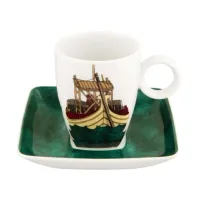
Vista Alegre was the first industrial unit engaged in porcelain production in Portugal. The determination of its founder, José Ferreira Pinto Basto, contributed to the brand's enormous success worldw
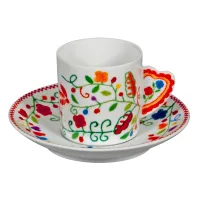
Manufactory Vista Alegre was the first industrial unit dedicated to porcelain production in Portugal. The determination of its founder, José Ferreira Pinto Basto, contributed to the brand's enormous
Description
Large Empire coffee pot in silver from Milan, early 19th century, in good condition.
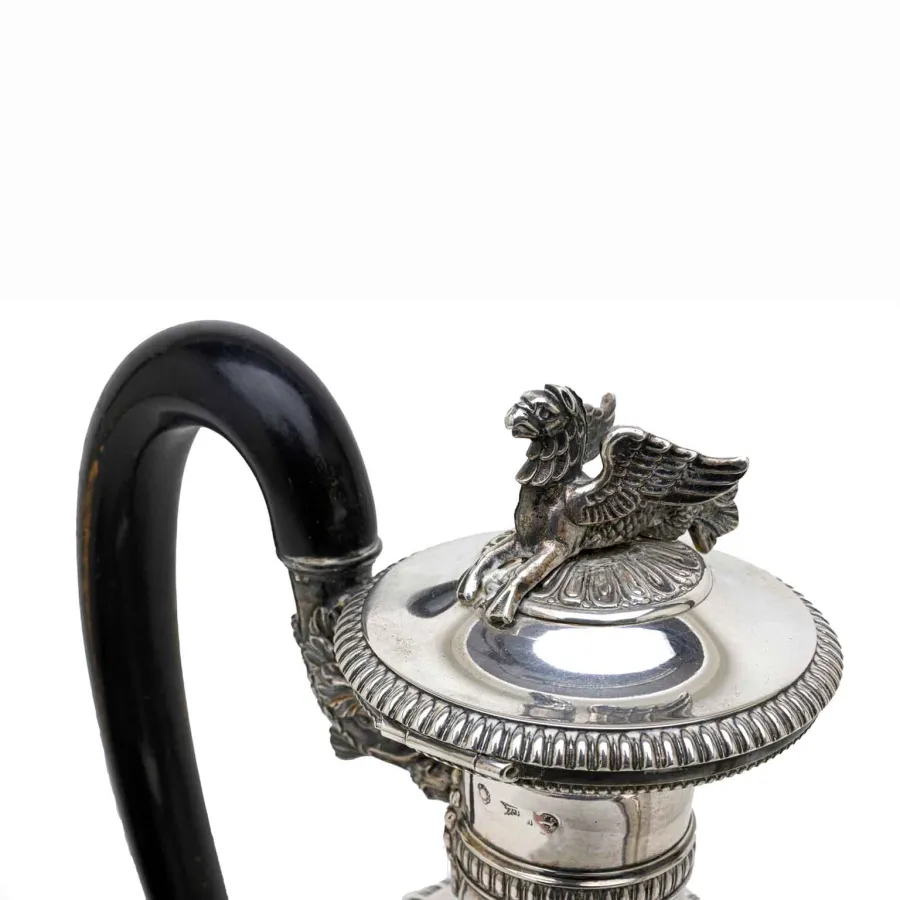
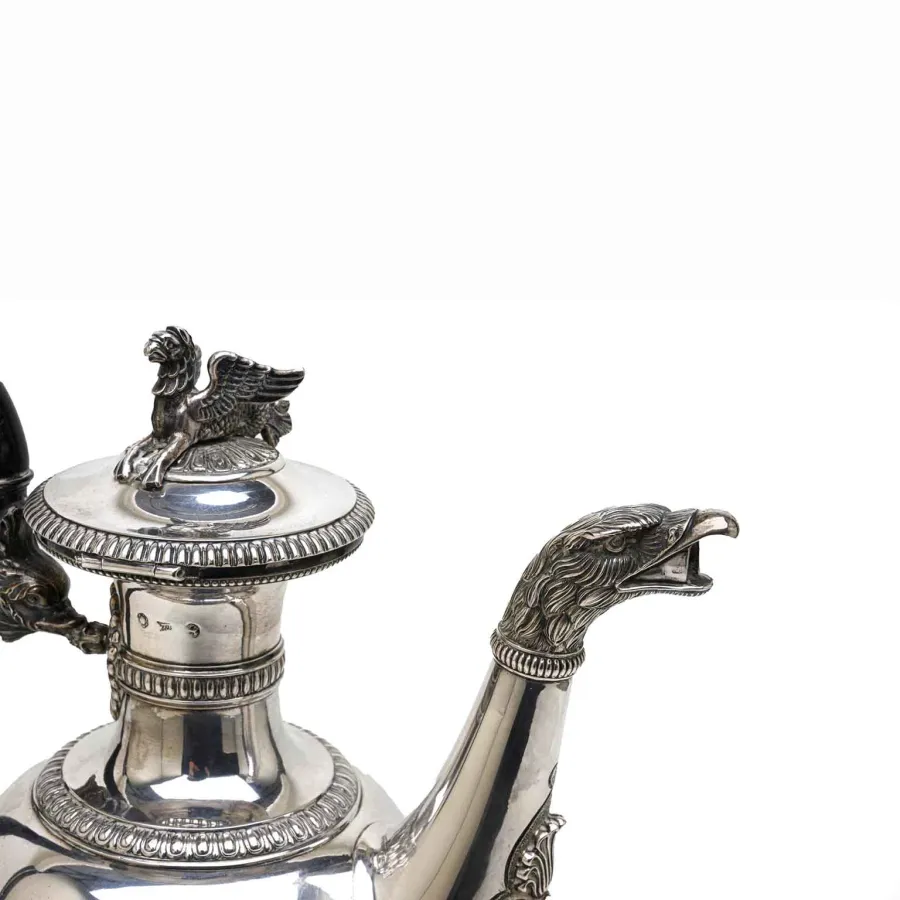
This elegant silver Empire coffee pot bears traces of the plow related to the second silver hallmark (800/000), originating from a world with seven trions referring to the Milan Guarantee Office between 1812-1872, as well as the F.L. silver hallmark associated with goldsmith Francesco Liverti under the Cow mark on a round field, documented until 1820 in Milan.
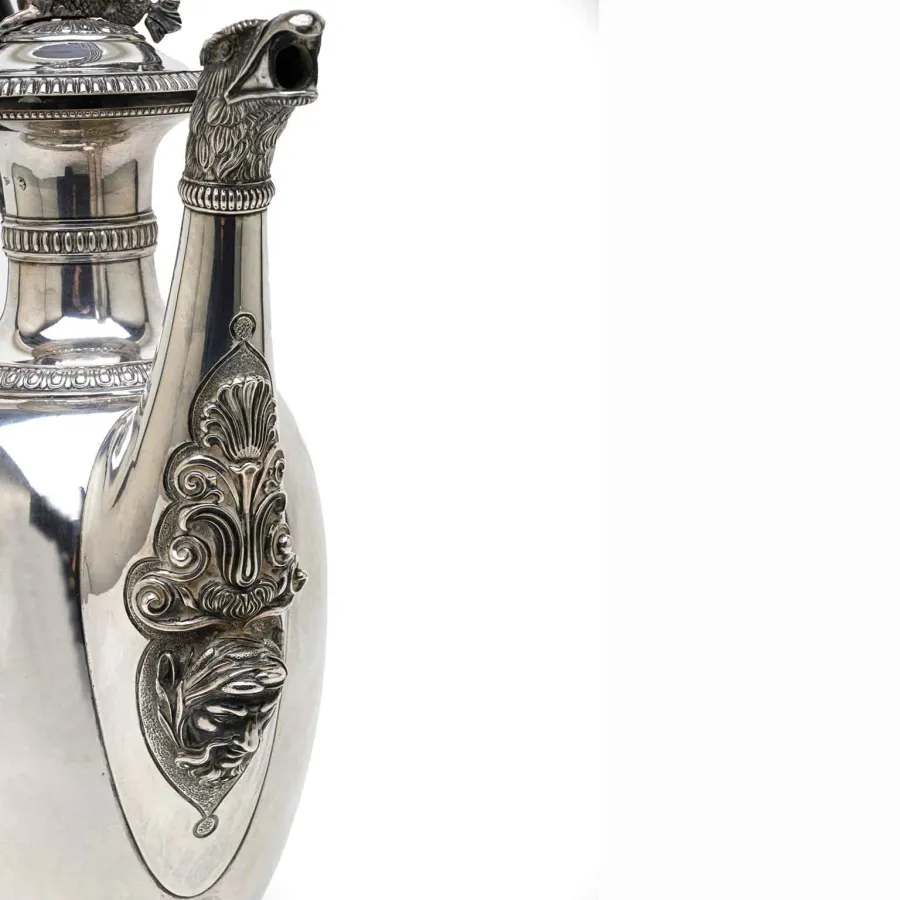
This ancient coffee pot made of melted, stamped, and engraved silver features an elongated, egg-shaped central body with a monogram AB engraved on it, a clearly tapered neck characteristic of Milanese and Lombard coffee makers from the first quarter of the 19th century. It is mounted on a round base and has a beak decorated with a mask, ending with an eagle’s head. The lid has a chimera-shaped socket. The handle made of ebonized wood is connected to the body with two hammered silver fittings, the upper shaped like a delfin and the lower with phytomorphic motifs.
It bears the aforementioned marks at the base and neck and weighs 1240 grams gross.
The mark from 1812-1872 clearly reproduces the cow symbol and is attributed to goldsmith Francesco Liverti. However, no documentation confirming this has been found, and the feature is not included in Milanese depositions or mark registrations. Nevertheless, it is highly probable because Liverti, born on August 14, 1765, in Ambrogio to Laura and Reina, ran a shop at his home in the Bocchetto district, 2534. Francesco Liverti died in 1820, and his business was continued by his widow until 1828. Thanks to this mark, numerous neoclassical cutlery pieces have been identified, all elegant and well-made… G. Sambonet, Milan 1987, p. 303.
Elegant antique furniture and accessories can be an excellent idea for decorating our interiors. Today, there is an increasing number of enthusiasts for high-quality vintage items that possess a specific character and soul. It’s a nod to history, craftsmanship, and the design of classic and timeless furniture. There are many different styles in antique furniture, each with its distinctive features.
Many styles characterize antique furniture, but a few are particularly notable. Eclectic furniture refers to the 19th century, dominated by the Biedermeier style. Its early variations include neogothic, Gothic, Rococo, Louis-Philippe style, and finally the English Victorian style. By the end of the century, these styles evolved into pseudo styles of classicism, Renaissance, and Baroque.
Empire-style furniture and accessories date from the late 18th to early 19th century. Everything was influenced by Napoleon’s reign, which imposed a strong resemblance and references to Roman and Greek ornamentation.
Neoclassical furniture is associated with Louis XVI style, which also draws heavily from ancient architecture. Interesting and noteworthy are antique products in Rococo style and Louis XV. The next is Baroque, a term derived from the Portuguese 'barocco'—meaning an irregularly developed pearl. These were highly decorative pieces meant to shine with splendor and play a significant role in luxury. Materials were chosen selectively to emphasize the grandeur of these items.
Today, we can observe how much the Baroque style influenced modern classic furniture, which is designed with a strong resemblance to the past era. An important style is also Renaissance, which flourished in the 15th and 16th centuries and left a significant mark on furniture-making. Renaissance furniture was quite heavy and massive, using brown stains, moldings, strong bases, and bas-reliefs. These products were quite distinctive but also opened new possibilities, such as the construction of credenzas and broadly speaking, chest furniture. They also drew inspiration from mythology and antiquity, with supports and legs often taking animal forms.
Lion paws, eagle heads – these are common sights especially in Renaissance style. Currently, many global brands reproduce furniture crafted in this style, drawing inspiration from Italian or French creators. This reflects admiration and respect for the history of the most beautiful Renaissance antiques. It is important to remember that each country perceived furniture production differently, so each style in a given nation had its own distinct character. This is especially important when searching for the perfect exclusive antique for your interior.The most important aspect of vintage styled furniture is originality. And this is ultimately crucial from the buyer’s perspective, as the market is flooded with many counterfeit items. Luxury Products provides a certificate confirming the product’s authenticity and compliance with the description and photos. We have appraisers, art experts, historians, and specialists from around the world at your disposal.
Attributes / Details
| SKU | ANT-A648 |
| Manufacturer | Antyki |
| Model | A648 |
| Material | silver |
| Size | Height: 38 cm Width: 24 cm Depth: 13 cm Diameter: base 12 cm |
| Age | 19th century |
| Year | 1801 |
| Style | Empire |
| Destiny | To living room |
See catalog
Reviews
No reviews for this product.