


Why Your Five-Year-Old Couldn't Do It Modern Art Explained - Thames and Hudson
Attractive editions of books.
SKU: THANDSON-9780500290477
See other products from category A gift for a bookworm or from manufacturer Thames and Hudson
Related products by category

Hand-drawn Andy Warhol books from the 1950s, created before his rise to fame, are highly sought-after gems in the pop art master’s crown. This portfolio includes meticulous reproductions of all seve


Antony Gormley holds a remarkable position as a highly popular sculptor — best known for his Angel of the North (1998), a national symbol in the United Kingdom — which is also widely regarded as o
Leonardo da Vinci may be best known to us as the artist behind masterpieces such as the Mona Lisa and The Virgin on the Rocks.However, Leonardo was infinitely curious about the physical world. His inc

For everyone who values comfort, we present a leather neck strap case for glasses! The case is handcrafted from the highest quality natural Ubrique leather - bovine - and is produced by the Spa

These three A6 notebooks – one lined, one blank, and one with grid – each with a different wide cover design than the Kells Book. The Book of Kells is one of the best-preserved objects from mediev

We are pleased to present to you a magnifying glass by Anframa, crafted from high-quality materials.The desk magnifier is undoubtedly an ideal corporate gift and an elegant present for various occasi

David Hockney contemplates life and art, experiencing lockdown in rural NormandyHistory of Thames & HudsonWalter Neurath was born in Vienna in 1903. In 1938, he left his hometown — where he ran

Rock Covers offers over 750 album covers that have shaped rock history. From legendary to rare releases, from Elvis Presley to Iron Maiden, these indelible markers of musical memory are accompanied by

Description
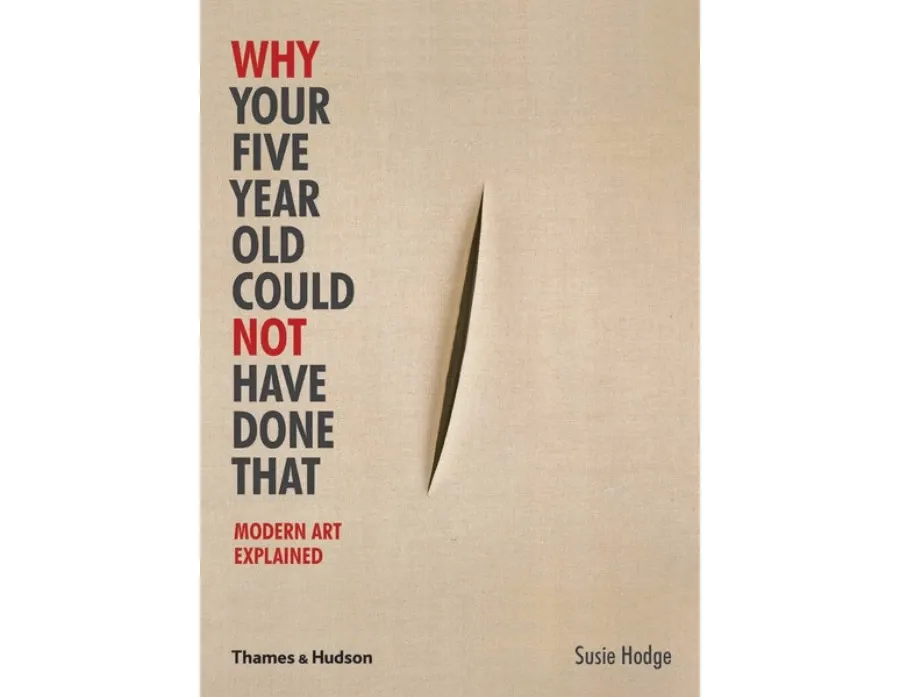
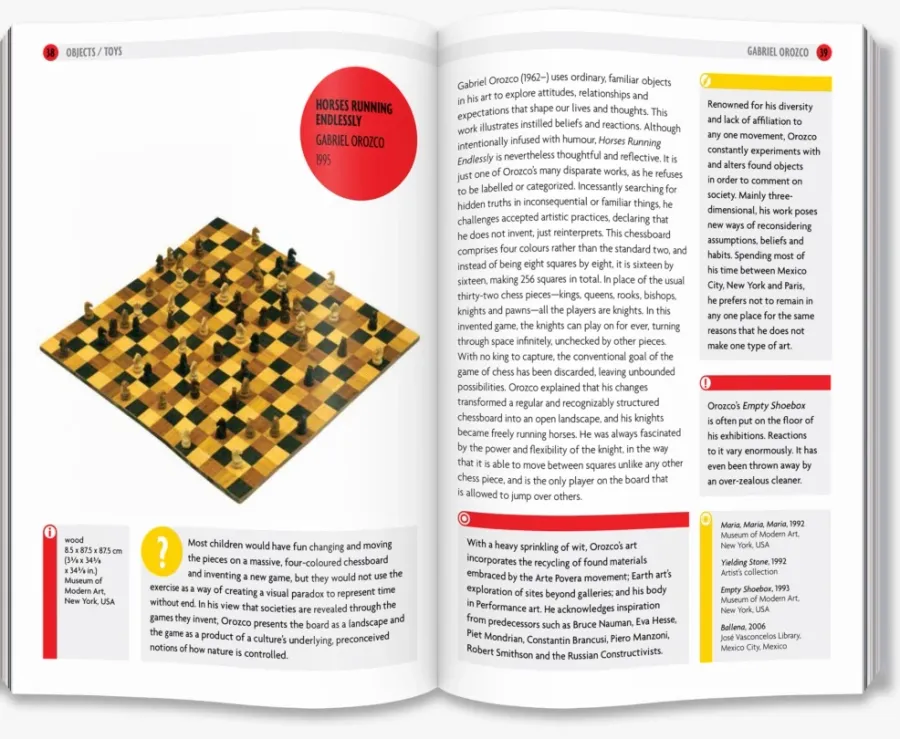
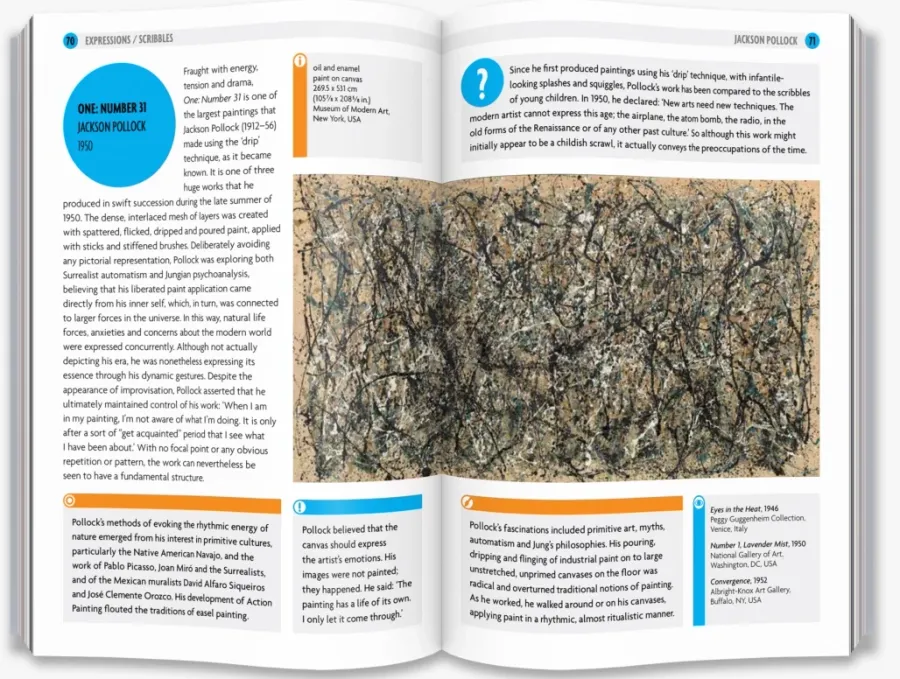
In the past, the evaluation of an artist's posture heavily emphasized their technical ability to accurately reproduce the real world on paper or canvas, or figures in wood or stone. An official portrait was meant to be a true and faithful likeness, and landscapes had to be recognizable in all details. However, especially after the advent of photography, many artists stopped creating such “true” likenesses in favor of more direct images that aimed to express feelings about their subjects. Often, a “simple” line replaced the careful details of earlier artists. From the very beginning of this maritime shift in artistic ambitions, critics confused the apparent lack of technique with a lack of artistic sophistication, often mocking expressive works as nothing more than untrained efforts by children. Susie Hodge examines 100 works of contemporary art that provoked critical hostility—from Cy Twombly’s scribbled Olympia (1957), primitive yet spontaneous Jean-Michel Basquiat’s LNAPRK (1982), to the seemingly careless chaos of Tracey Emin’s My Bed (1998)—and explains how, rather than being insignificant novelties, they are sources of inspiration and a logical extension of the artistic ideas of their times.
She explains how “notorious” works, such as Carl Andre’s Uncarved Blacks (1975)—a rectangular arrangement of red cedar blocks, which a child could easily copy—occupy unique niches in the history of ideas, demonstrating influences from past artists and themselves influencing subsequent artists. A five-year-old could create a spin painting like Damien Hirst’s without understanding the ideas behind it or its place in art history, but this does not mean that such work holds significance for artists and historians. Susie Hodge clearly and unambiguously explains why contemporary art is not and has never been a child’s play. Through illustrations of works by Hans Arp and Andy Warhol, Hodge places each piece in a cultural context to present an unforgettable vision of contemporary art. This book will help you understand how contemporary art differs from realistic works of earlier centuries, evolving and also informing visits to galleries over many years.
The Thames & Hudson brand was founded in 1949 by Walter and Eva Neurath. Their greatest passion and mission was to create a “museum without walls” and to make the world of art and leading scientific research accessible to a broad audience. To reflect international perspectives, the company’s name combined the rivers flowing through London and New York, represented in its logo by two dolphins symbolizing friendship and intelligence, one facing east, the other west, suggesting a connection between the Old World and the New.
Today, still an independent, family-owned company, Thames & Hudson is one of the world’s leading publishers of illustrated books, with over 2,000 titles in print. It publishes high-quality books across all areas of visual creativity: fine arts (fine arts, applied arts, decorative arts, performing arts), architecture, design, photography, fashion, film, and music, as well as archaeology, history, and popular culture. It is also expanding its list of children’s books. Headquartered in London with a sister company in New York and branches in Melbourne, Singapore, and Hong Kong. In Paris, another subsidiary, Interart, distributes books in English within France.
History of Thames & Hudson
Walter Neurath was born in Vienna in 1903. In 1938, he left his hometown—where he ran an art gallery and published illustrated books—for London. Initially, he worked as a production director at Adprint, a company founded by Viennese émigré Wolfgang Foges. Neurath and Foges developed a pioneering concept of what is now called book packaging (or co-publishing), where book ideas are developed, commissioned, produced, and sold by publishers operating across different markets and languages to create large editions and thus reduce unit production costs. Neurath’s concept was the first of many innovations that Thames & Hudson introduced to the publishing world.
In order to continue packaging books in the second edition and recognizing the need to amortize the high costs of producing illustrated books, Neurath established his own publishing house, with offices in London and New York, in the autumn of 1949. Eva Neurath, who arrived in London from Berlin in 1939, was a co-founder.Of the ten titles published on Thames & Hudson’s first list in 1950, *English Cathedrals*, with photographs by Martin Hürlimann, was the first and achieved the greatest success. The firm’s strong conviction in the longevity of books was evident from the very beginning, and the title remained in print until 1971. In the first year of publication, Albert Einstein’s *Out of My Later Years* also appeared, an early indicator of the program’s breadth. As the list gradually expanded—from ten titles in 1950 to 144 in 1955—the company moved its offices from High Holborn to a Georgian townhouse at 30 Bloomsbury Street, near Bedford Square, in 1956, becoming the epicenter of book publishing in London. The manufacturing remained at this address, eventually expanding to five houses by 1999, when it returned to High Holborn.
In 1958, Thames & Hudson launched one of its most renowned series, *World of Art*, which became the foundation of a highly diverse list. Characterized by pocket-sized editions with black spines, the series expanded in just seven years to include 49 titles. Nearly 60 years later, the series boasts over 300 titles, which, according to Christopher Frayling, are “stained with paint copies” in every art school across the country.
Other significant series that added depth and prestige to the list include *Ancient People and Places*, edited by Glyn Daniel, who from the 1950s contributed to pioneering interest in archaeology, both in book form and on television. Over 34 titles have been published in this series over 34 years. The large-format *Great Civilizations* series, published in 1961, included contributions from esteemed scholars such as Alan Bullock, Asa Briggs, Hugh Trevor-Roper, A. J. P. Taylor, and John Julius Norwich.
After building one of the most important publishing houses in Europe in less than two decades, Walter Neurath died in 1967 at the age of 63. Sculptor Henry Moore wrote that “his death was a loss to our cultural life.” Sir Herbert Read noted that Neurath “more than anyone else was responsible for the revolution in art publishing” and was “one of those rare entrepreneurs who successfully combine business acumen with idealism.” Eva Neurath became the chairwoman. Walter’s son, Thomas, who joined the company in 1961 along with his sister Constance, became managing director; Constance later served as artistic director for several decades. Both Thomas and Constance remain on the Thames & Hudson board, as do Thomas’s daughters, Johanna and Susanna.
From producing the first commercial edition of *The Book of Kells* to the triumphant publication of the six-volume *Vincent van Gogh – Letters*, from technological innovations like “French folds” to the controversial documentation of graffiti art in *Subway Art*, Thames & Hudson has always been at the forefront, both culturally and in production techniques.
The year 2016 marked an extraordinary new chapter for the company, announcing publishing partnerships with two of the world’s most important museums: the British Museum and the Victoria and Albert Museum.
The world of art and scholarship remains at the heart of Thames & Hudson’s publishing program, which remains true to its fundamental principle: providing a “museum without walls.”
Today, Thames & Hudson is a recognizable international brand, a symbol of British publishing. Its extensive catalog includes thousands of original titles, many of which are luxury collector’s editions.
Attributes / Details
| SKU | THANDSON-9780500290477 |
| Manufacturer | Thames and Hudson |
| Model | Susie Hodge |
| Author | 9780500290477 |
| Number of pages | 224 |
| Tongue | English |
| Year of release | 1 October 2012 |
| Size | 19.7 x 14.0 cm |
See catalog
Video
Reviews
No reviews for this product.