

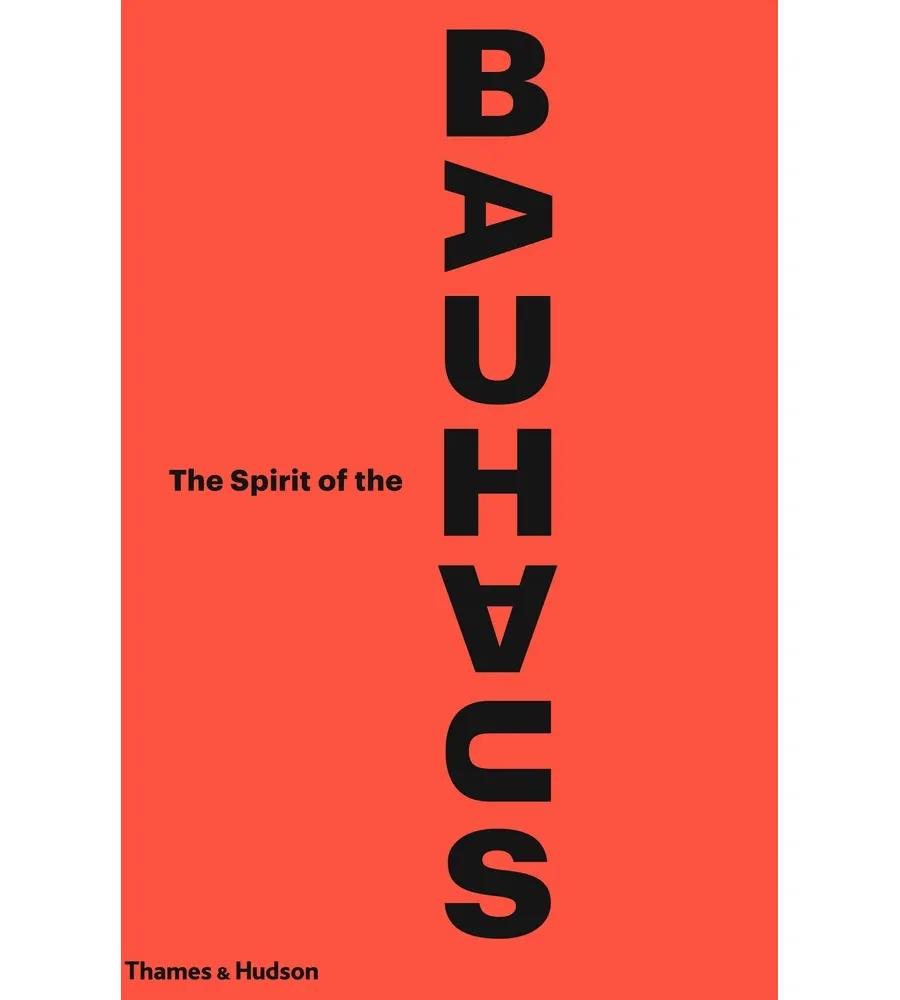
The Bauhaus Spirit book - Thames & Hudson
Wonderful editions of books
SKU: THANDSON- 9780500021804
See other products from category Books about architecture and design or from manufacturer Thames and Hudson
Related products by category

This inventive social, economic, and ecological experiment. Bjarke Ingels Group is a radical architectural manifesto within a comic strip. The pioneering company uses a cartoon format to declare its c

Luxury Products LibraryAll books in our store come from official European distribution.Language of publication: English.TITLE: That Wild Country: An Epic Journey through the Past, Present, and Future

An essential book for enthusiasts of treehouse projects worldwide. This quirky collection showcases 50 of the best treehouses around the globe. Whether it's an inspiring look back at childhood adventu
Luxury Products LibraryAll books in our store come from official European distribution.Language of publication: English.TITLE: A World of ArtAuthor: Helena HuntISBN: 978-1-4063-9389-7

Revisit the 90s again in an extensive compendium of advertising gems that sold Generation X and the baby boom everything from Game Boys to Boyz II Men. Six chapters dedicated to food, fashion, enterta

Otto Wagner was a realist and at the same time a visionary, architect, and builder who ushered in a new era in construction. Born in Vienna, this visionary architect felt his presence — he was a pio

This exciting study focuses on the most thrilling and groundbreaking manifestations of English architectural genius.With great verve and scholarship, Alec Clifton-Taylor guides us through nine centuri
One of the most transformative forces in the history of design was the creative duo Charles and Ray Eames : through furniture, photography, architecture, textile design, industrial design, and f

Once synonymous with dilapidated highway overpasses, walls are now a hit of architecture. This edition of Bibliotheca Universalis covers the intricate feats and extraordinary engineering of contempora
Ancient Egyptian, Greek, and Indian thinkers understood that numbers govern what they saw in their world, and therefore approached their divine creator accordingly. Robert Lawlor describes a system th
Description
“Architects, sculptors, painters, we all need to return to craftsmanship!” declared architect Walter Gropius in his Bauhaus manifesto. Founded as an art school in 1919 and forced to close by the Nazis in 1933, Bauhaus had a significant influence on 20th-century art and design that endures to this day. Students were taught by some of the most renowned artists of the time, including Paul Klee, Lyonel Feininger, and Wassily Kandinsky. The school moved from Weimar to Dessau in 1922 under the leadership of the radical new director Hannes Meyer, and then to Berlin in 1932 under architect Ludwig Mies van der Rohe. In 1933, the Gestapo forced Bauhaus to close for the final time.
This volume explores the sources of inspiration that led to the creation of Bauhaus, from medieval European cathedrals and Hokusai's graphics to William Morris and the Arts and Crafts movement. Each of the various workshops and courses at Bauhaus is examined in detail, illustrating the extraordinary richness of experimentation across all fields: ceramics, carpentry, metalwork, textiles, stained glass painting, sculpture, murals, printing and binding, typography and advertising, theatre, architecture, and photography.
This accessible guide to Bauhaus, its history, and its turbulent political context provides the key to understanding why it is regarded as one of the most enduring and influential sources of modern ideas on art, design, and craftsmanship.
Thames & Hudson was founded in 1949 by Walter and Eva Neurath. Their greatest passion and mission was to create a “museum without walls” and to make the world of art and leading scientific research accessible to a broad audience. To reflect international perspectives, the company's name combined the rivers flowing through London and New York, represented in its logo by two dolphins symbolizing friendship and intelligence, one facing east, the other west, suggesting a connection between the Old World and the New.
Today, still an independent, family-owned company, Thames & Hudson is one of the world's leading publishers of illustrated books with over 2,000 titles printed. It publishes high-quality books across all areas of visual creativity: fine arts, applied arts, decorative arts, performing arts, architecture, design, photography, fashion, film, and music, as well as archaeology, history, and popular culture. It is also expanding its list of children's books. Headquartered in London with a sister company in New York and branches in Melbourne, Singapore, and Hong Kong. In Paris, another subsidiary, Interart, distributes English-language books in France.
History of Thames & Hudson
Walter Neurath was born in Vienna in 1903. In 1938, he left his hometown—where he ran an art gallery and published illustrated books—for London. Initially, he worked as a production director at Adprint, a company founded by Viennese émigré Wolfgang Foges. Neurath and Foges developed a pioneering concept of what is now called book packaging (or co-publishing), where book ideas are developed, ordered, produced, and sold to publishers operating in different markets and languages to create large editions and thus reduce unit production costs. Neurath’s concept was the first of many innovations introduced to the publishing world through Thames & Hudson.
Seeking to continue book packaging in a second edition and recognizing the need to amortize the high costs of producing illustrated books, Neurath established his own publishing house with offices in London and New York in the autumn of 1949. Eva Neurath, who arrived in London from Berlin in 1939, was a co-founder.
In 1958, Thames & Hudson launched one of its most renowned series, *World of Art*, which became the foundation for a highly diverse list. Characterized by pocket-sized editions with black spines, the series expanded in just seven years to include 49 titles. Nearly 60 years later, the series boasts over 300 titles, which, according to Christopher Frayling, are “stained with paint copies” in every art school across the country.
Other significant series that added depth and prestige to the list include *Ancient People and Places*, edited by Glyn Daniel, who from the 1950s contributed to pioneering interest in archaeology, both in book form and television. Over 34 titles were published in this series over 34 years. The large-format *Great Civilizations* series, published in 1961, featured contributions from esteemed scholars such as Alan Bullock, Asa Briggs, Hugh Trevor-Roper, A. J. P. Taylor, and John Julius Norwich.
After establishing one of the most important publishing houses in Europe in less than two decades, Walter Neurath died in 1967 at the age of 63. Sculptor Henry Moore remarked that “his death was a loss to our cultural life.” Sir Herbert Read noted that Neurath “more than anyone else was responsible for the revolution in art publishing,” and he was “one of those rare entrepreneurs who successfully combine business acumen with idealism”. Eva Neurath became chairwoman. Walter’s son, Thomas, who joined the company in 1961 along with his sister Constance, became managing director; Constance later served as artistic director for several decades. Both Thomas and Constance remain on the Thames & Hudson board, as do Thomas’s daughters, Johanna and Susanna.
From producing the first commercial edition of *The Book of Kells* to the triumphant publication of the six-volume *Vincent van Gogh – Letters*, from technical innovations like “French folds” to the controversial documentation of graffiti art in *Subway Art*, Thames & Hudson has always been at the forefront, both culturally and in production techniques.
The year 2016 marked an extraordinary new chapter for the company, announcing publishing partnerships with two of the world’s most important museums: the British Museum and the Victoria and Albert Museum.
The world of art and scholarship remains at the heart of Thames & Hudson’s publishing program, which remains true to its core principle: providing a “museum without walls.”
Today, Thames & Hudson is a recognizable international brand, a symbol of British publishing. Its extensive catalog includes thousands of incredible titles, many of which are luxurious collector’s editions.
Attributes / Details
| SKU | THANDSON- 9780500021804 |
| Manufacturer | Thames and Hudson |
| Model | 9780500021804 |
| Author | Olivier Gabet, Anne Monier |
| Number of pages | 264 |
| Tongue | English |
| Year of release | March 15, 2018 |
| Size | 30.2 x 23.7 cm |
See catalog
Reviews
No reviews for this product.