
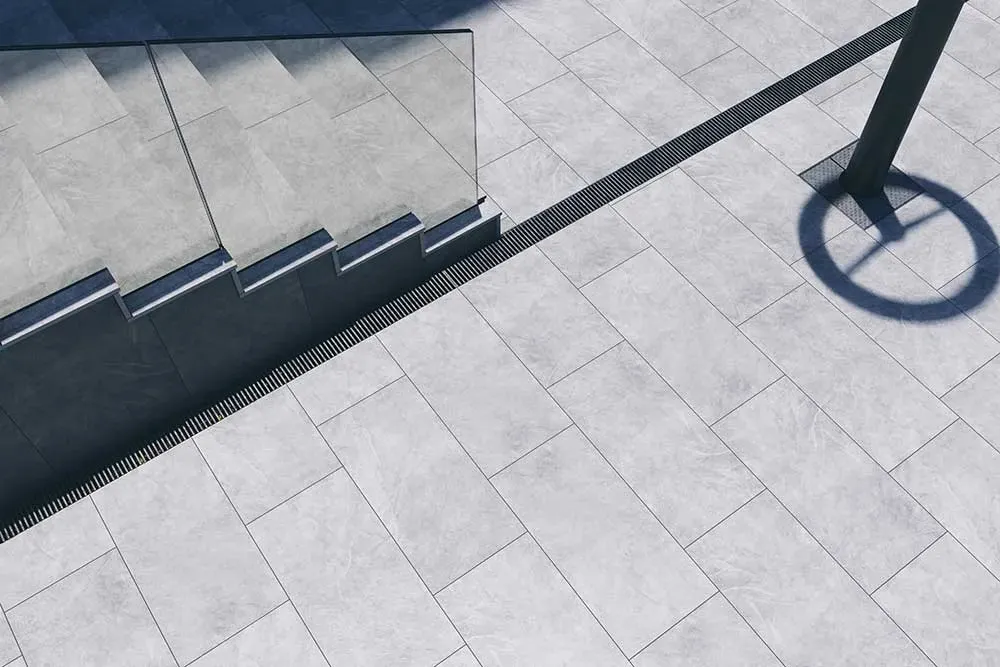
For years, we were told that “nothing can replace real stone.” Investors long paid a high price for this — not only at the time of purchase but primarily during use. impregnation, moss removal, fighting lime deposits… do we really have to accept this in the 21st century? Today, tiles that imitate natural stone are no longer “cheaper alternatives,” but a modern solution that has extracted the most beautiful elements from nature while eliminating its physical flaws. Find out why architects are increasingly choosing porcelain stoneware over quarries.
Perfect illusion thanks to stone-like tiles for outdoor use
Just a decade ago, the word „imitation” in the context of ceramics might have been associated with a flat print and artificially repetitive patterns. However, those times are gone forever, and nowadays, it is more common to speak of being inspired by nature rather than copying it. Modern stone-imitating gres tiles replicate even the smallest geological nuances.
The foundation of authenticity lies in structure and diversity. Manufacturers have moved away from creating identical „stamps”, which helps avoid the artificial checkerboard effect. The surface is heterogeneous, full of tonal transitions, quartz veins, and natural abrasions, just like in nature. This fidelity is not only visual – touch matters too. The texture of outdoor stone-like tiles is three-dimensional and correlated with the graphic. If you see a crack or roughness of granite, you will feel it under your fingertips as well.
It turns out that gres even visually surpasses its natural counterpart – it wins with color stability. Natural rocks, under UV radiation, can change color over time, turn gray, or yellow (especially limestones and sandstones). Choosing tiles ensures that deep graphite or warm beige will remain the same for decades to come.
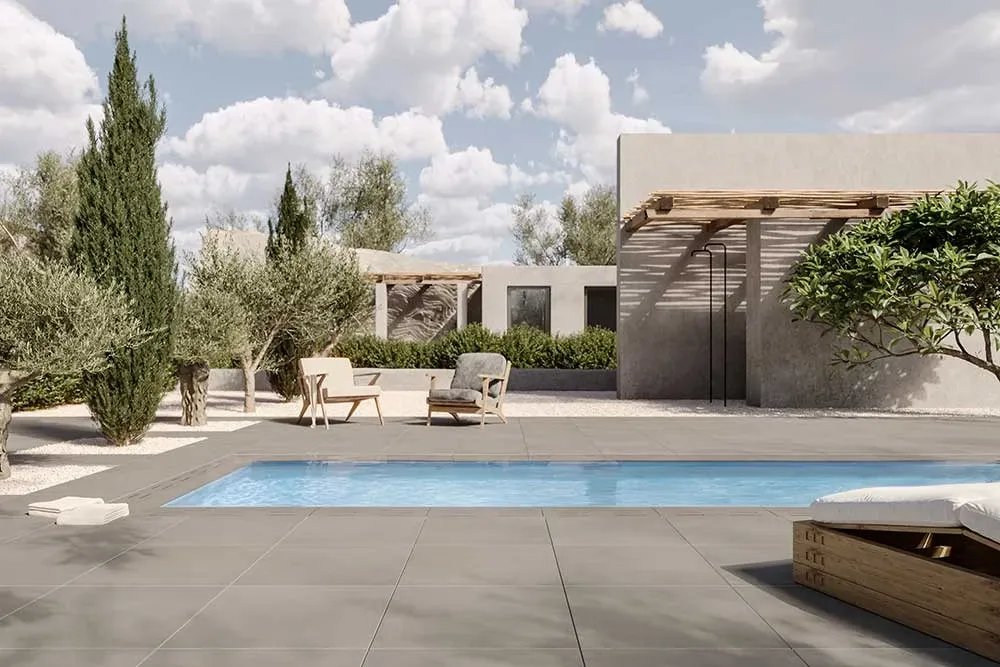 photo: plytyzewnetrzne.pl
Technical advantages of stone-like tiles
Appearance is not everything, especially in our climate zone. The biggest issue with many natural materials (such as sandstone or travertine) is porosity. Microcracks allow water to penetrate, which freezes and expands, leading to cracks or chips (known as freeze-thaw erosion). Stone-imitating gres tiles are pressed under high pressure and fired at extremely high temperatures, resulting in a dense structure and near-zero absorbency. Complete frost resistance surpasses natural materials.
The second issue is stain resistance. Grease from a barbecue, spilled red wine, or wet leaves left on natural stone in autumn often cause permanent discoloration. With gres tiles that imitate stone for outdoor use, dirt does not penetrate the material. Usually, cleaning only requires water, and if necessary, a pressure washer can be used without worry, although it may be risky on delicate, stone-like textures.
Finally, a pragmatic argument – no impregnation needed. Stone, to prevent graying or moss growth, requires regular maintenance. By choosing gres, you opt for a maintenance-free material.
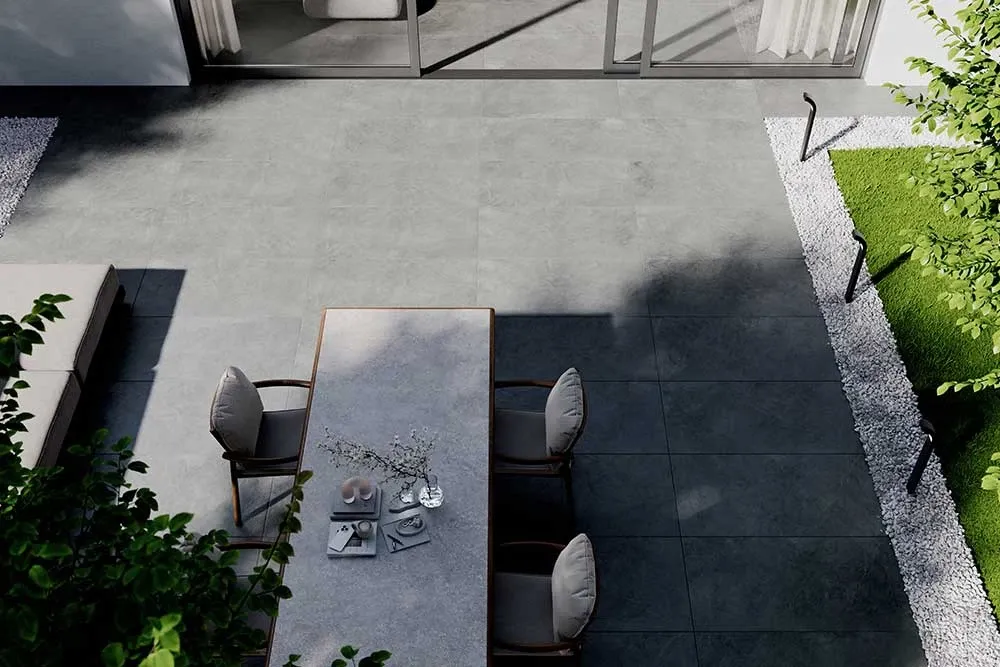 photo: plytyzewnetrzne.pl
Titanic durability of gres tiles imitating stone
When we think of ceramic tiles, we usually imagine a finishing material about 8-10 mm thick. However, in outdoor spaces, where surfaces are subjected to enormous pressure and dynamic loads, standard solutions are inadequate. The STAR series combines the aesthetics of stone (as well as wood and concrete) with the durability parameters of gres.
What are the available variants of stone-imitating tiles:
• STAR 2.0 – 2 cm thick gres, which is the technological standard for pedestrian pathways and terrace surfaces. Its load resistance is many times higher than thinner tiles. Thanks to this, the material is ideal for ventilated terrace systems (on supports), ensuring stability and safety without the need for permanent bonding to the substrate.
• STAR 3.0 – a solution designed for high-traffic areas. Increasing the thickness to 3 cm has allowed for parameters that enable the use of gres on driveways, garages, and maneuvering yards. These stone-like outdoor tiles easily withstand the pressure of passenger and delivery vehicles, providing an aesthetic alternative to cobblestone or concrete.What is the advantage of gres? To achieve similar crack resistance, natural stone would need to be significantly thicker and heavier, complicating logistics and installation. STAR series tiles offer the same, often higher, load-bearing capacity while maintaining precise calibration.
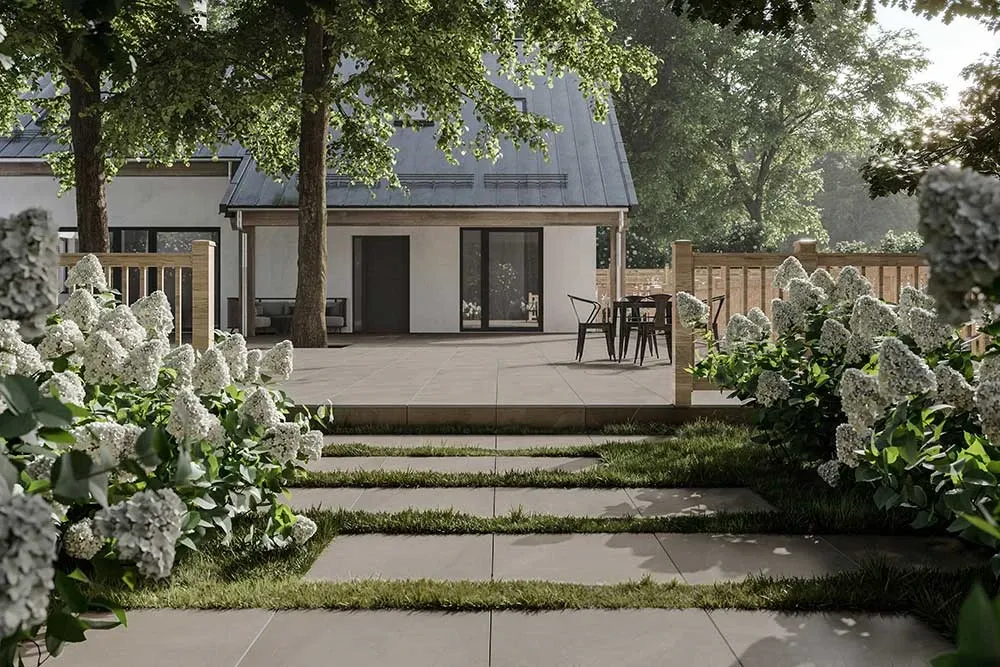 photo: plytyzewnetrzne.pl
Ease of installation of stone-like tiles
When choosing natural stone, we often forget about hidden costs, such as installation. Split sandstone or granite have irregular edges and varying thicknesses – only a highly skilled professional can fit the elements and apply grout of the appropriate width.
With gres tiles imitating stone, this problem disappears. STAR series gres are rectified, meaning they have perfectly straight edges and dimensional accuracy. Finishing work takes less time, and the grout is barely visible.
Moreover, 2- and 3-cm thick gres open the door to so-called dry installation – on supports, gravel, or directly on grass. This technology is impossible with irregular split stone. Nature is an undeniable inspiration, but in construction, predictability and durability are key. With stone-like outdoor tiles, you gain the noble aesthetic of rock while eliminating its disadvantages.
Sponsored article