Painting walls with paints is one of the easiest and fastest ways to finish them. The wide range of colors offered by manufacturers allows you to choose a paint color for any interior design.
In addition to paints, you can finish both dry and damp rooms with them. What is the downside of this type of finish? A uniform, single-color surface can often be monotonous and simply boring. To enrich it, many people hang decorations and posters on the wall. Below you will find another solution to the problem of monotonous, single-colored walls. Thanks to it, you will achieve a stunning design effect.
What are decorative paints?
Among the offerings of paint manufacturers, you will also find decorative paints. What exactly distinguishes them from acrylic, latex, or vinyl paints? Primarily their structure, color, and finish.
Depending on the type, decorative paints contain additional pigments or natural mineral fillers of various fractions. This type of paint includes the popular "baranek" (sheep's fleece), which was once commonly used to finish hallway walls. Today, it is much more often seen outdoors than inside buildings.
Decorative paints allow you to achieve effects resembling natural stone, plaster, gypsum, or even marble. In children's rooms, colorful paints can be used to create cosmic nebula effects. The variety of patterns and colors available for decorative paints is not their only advantage. It’s worth remembering that you can cover all walls, just part of them (e.g., the most exposed areas), or selected fragments. This provides many design possibilities to enliven uniform walls in hallways or any other room.
How to use decorative paints in the hallway?
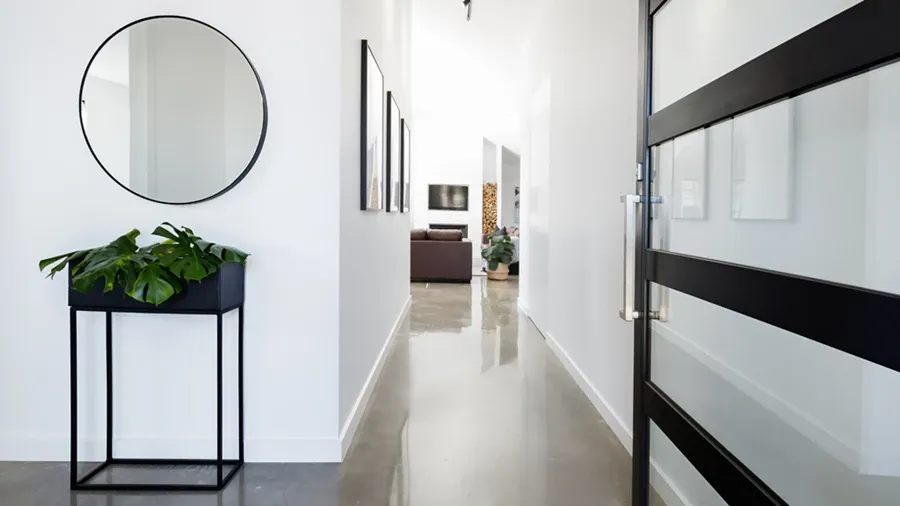
In a narrow hallway, walls are most often not covered by furniture or shelves, which simply leave no space. For this reason, wall decoration in this area is especially important. It’s through it that you can emphasize the interior’s design style. You can hang posters or paintings on the walls or utilize the potential of decorative paints.
In industrial-style arrangements, paint your walls with a concrete-effect paint. Its light color contrasts beautifully with the red brick placed on a section of the wall. It’s worth illuminating it with a narrow wall lamp.
In Scandinavian arrangements, you can opt for the traditional sheep's fleece, but this time in a minimalist version. Use wall moldings to create a modern wainscoting in your hallway, finishing its upper part with a textured paint and painting it in a warm beige color.
With paints that have a pronounced texture, you can fill in plaster moldings, creating an interesting and original wall decoration.
There are many ways to use decorative paints. They are perfect for decorating uniform and monochromatic walls in hallways. You can choose products with a distinct texture or those with an original, standout color. In industrial arrangements, a concrete-effect paint works great, while in Scandinavian styles, the traditional sheep's fleece can complement modern wainscoting.
SPONSORED ARTICLE