It is estimated that 90% of "LV" products on the secondary market are counterfeit. Sounds abstract? Not for Karolina, an influencer from Kraków, who showcased a collection of thirteen Louis Vuitton bags on her Instagram. The problem was that during customs inspection, it turned out that only four of them were authentic.
Such situations happen more often than you think. People spend a fortune on items they believe are authentic, only to find out later that they bought a counterfeit. Honestly, I almost fell into such a trap myself when buying second-hand.
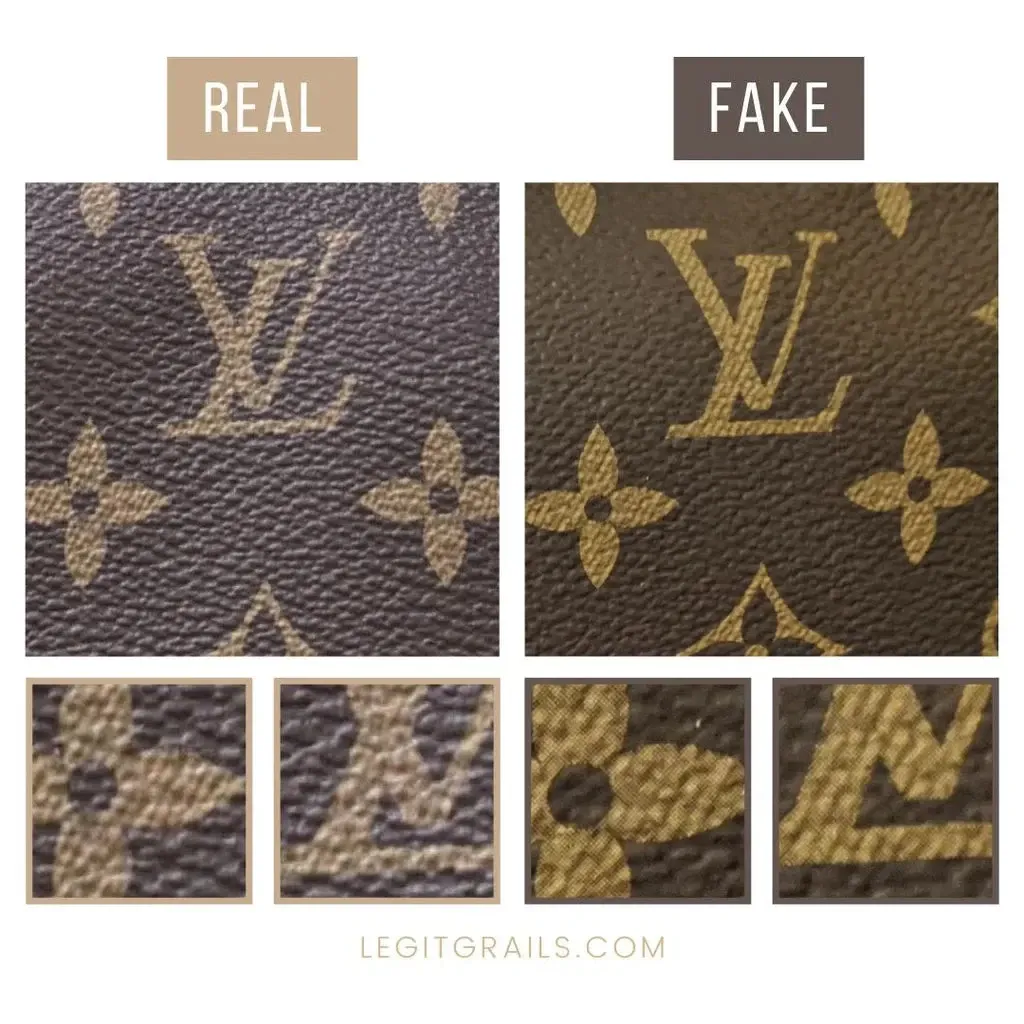
 Photo: legitgrails.com
Louis Vuitton is valued at 124 billion USD (Forbes 2024) — it’s no coincidence that this brand is so frequently counterfeited. High prices mean that any mistake in assessing authenticity can be very costly. It’s not just about money, although that’s important.
Imagine carrying a bag for months, believing it’s genuine. You tell friends about your purchase, post photos. And then someone points out a strange stitch or an unusual leather color. That awareness that you might have been mistaken is a truly unpleasant feeling.
That’s why it’s worth learning how to distinguish genuine from fake.
In the following parts of this guide, I will show you specific physical features to pay attention to. We will also discuss date codes — those small marks that can reveal a lot about the bag’s origin. Finally, we will review available verification tools that can help you make a confident decision.
Some say it’s paranoia. I believe it’s simply common sense. Especially when you’re buying something that costs several thousand złoty.
Let’s start with the basics — what you can see with the naked eye.
Original Louis Vuitton — a practical authenticity guide
Checking Louis Vuitton authenticity mainly involves what you see and feel at first glance. You don’t need any special tools — just know what to look for.
 Photo: legitgrails.com
Let’s start with materials. An original Louis Vuitton bag uses Vachetta leather, which naturally patinas over time. This leather initially has a light, creamy color, but after a few months of use, it turns honey-colored, then brown. Counterfeits often use synthetic leather, which has an artificial shine and does not change color over the years.
How many stitches per centimeter does an original bag have?
Exactly 5. That’s a standard Louis Vuitton has adhered to for decades. Check any part of the bag — if the stitches are uneven or their density varies, a red flag should go up. Uneven stitches are the first sign you’re dealing with a counterfeit.
The monogram pattern must align perfectly across all seams. That means if on one side of a stitch you see half of an L, on the other side, the second half should be visible. Also, pay attention to spelling — sometimes counterfeit bags have “Luis Vuitton” instead of “Louis”.
✔ Check the weight of zippers and clasps — authentic ones use only RiRi or Eclair
✔ Feel the weight of the metal — genuine elements are heavy and solid
✔ Examine the engraving — it should be clear and deep
✔ Touch the surface — it shouldn’t be rough or irregular
Interestingly, a few months ago I bought a bag on Vinted and only at home did I realize that the metal sounded different than it should. A light tapping revealed it was probably plastic painted gold.
Remember, all these elements must work together. One thing alone might be misleading, but if several don’t match, you can be confident. And if you want to be even more sure of your assessment, it’s worth checking the interior of the bag, where additional codes are hidden.
 Photo: legitgrails.com
Date codes and RFID: secret marks that reveal the origin
The interior of the bag holds the truth that counterfeiters often overlook. We're talking about date codes – small markings that since 1982 have served as secret signatures of the factory.
The system is simple: two letters plus four digits. The first letters indicate the factory code, followed by the week and year of production. Let's take the example "VI1023" – France, 10th week of 2023. Sounds complicated? Not at all once you get the rhythm.
Key factory prefixes include "FL" for France, "SD" for USA, "SP" for France (newer lines), or "MI" for France (specific series). Since 1982, this system has operated with few changes, although from 2024, RFID technology is also being introduced.
Examples of factory codes:
FL, VI, SP → France
SD, FH → USA
ARC → Spain
DR → Germany
This is where counterfeiters often slip up. I’ve seen fakes with the code "XX2501" – the letters XX do not exist in the Louis Vuitton system. Or worse – impossible dates like "FL5420," where week 54 in a year is pure fiction.
Another trap: absence of a code in a bag produced after 1982. That’s an immediate red flag. Some fakes have a code, but in the wrong place – the original is always embossed in the leather, never printed.
My friend once bought a "vintage" bag with the code "FL0178" – supposedly France, first week of 1978. The problem? The system was only introduced in 1982. Such an error cost her quite a bit of embarrassment.
The latest authentic pieces from 2024 already feature NFC technology – small chips from Aura Blockchain Consortium. This is the future of authenticity, but for now, it’s only in the newest collections.
Remember – each code has its logic and place in the brand’s history. When something doesn’t add up, the entire bag is usually suspect. That’s why it’s worth memorizing these rules.
 Photo: legitgrails.com
From magnifying glass to blockchain: tools of modern verification
Do you have a second-hand bag and have checked everything but still have doubts? I understand. Sometimes your own knowledge isn’t enough, especially when dealing with several thousand zloty.
Fortunately, we live in times when technology really helps. And I’m not talking about futuristic gadgets – just tools that already work.
The simplest solution? Visit a Louis Vuitton boutique. Seriously, there’s no shame in that. Staff there deal daily with authentic products and can instantly recognize fakes. Best of all – Louis Vuitton has an official policy of not charging for verification. Zero cost for peace of mind.
But maybe you don’t feel like going downtown? That’s when mobile apps come in. Entrupy is probably the most well-known – uses artificial intelligence and reportedly has over 90% accuracy. LegitGrails is also quite good. You take photos according to instructions, send them, and get an answer within minutes. Cost? About 100 złoty per verification.
And what about in a year or two? Louis Vuitton is already testing blockchain certificates for new collections. That means each bag will have a digital "passport" impossible to counterfeit. NFTs in the luxury industry are no longer science fiction – they’re a reality in 2024 and 2025.
The challenges ahead will only grow. Experts predict the counterfeit market will reach a trillion dollars by 2030. Artificial intelligence is doing its part – creating increasingly sophisticated fakes. These new "super-fakes" will be harder to detect even for specialists.
 Photo: legitgrails.com
But that’s exactly why your knowledge is so valuable now.
Remember one thing – when you buy an original, you’re not spending money. You’re investing it. In quality that will last for years. In style that won’t go out of fashion. In value that often only increases over time.
Every genuine handbag, watch, or pair of shoes is a piece of the brand's history. This craftsmanship is passed down from generation to generation. It cannot be replicated in a counterfeit factory, no matter how hard they try.Don't be fooled by shiny deals and overly promising promises. Trust your intuition, but most importantly — trust the methods you now know.
Your next investment in authenticity is already waiting for you. You're ready to recognize it.
"Authenticity is an investment, not an expense."
Hania ZZ
luxury lifestyle & fashion editor
Luxury Products